From 'ship it' to 'shut it down': how DevOps changed from 2016 to 2026
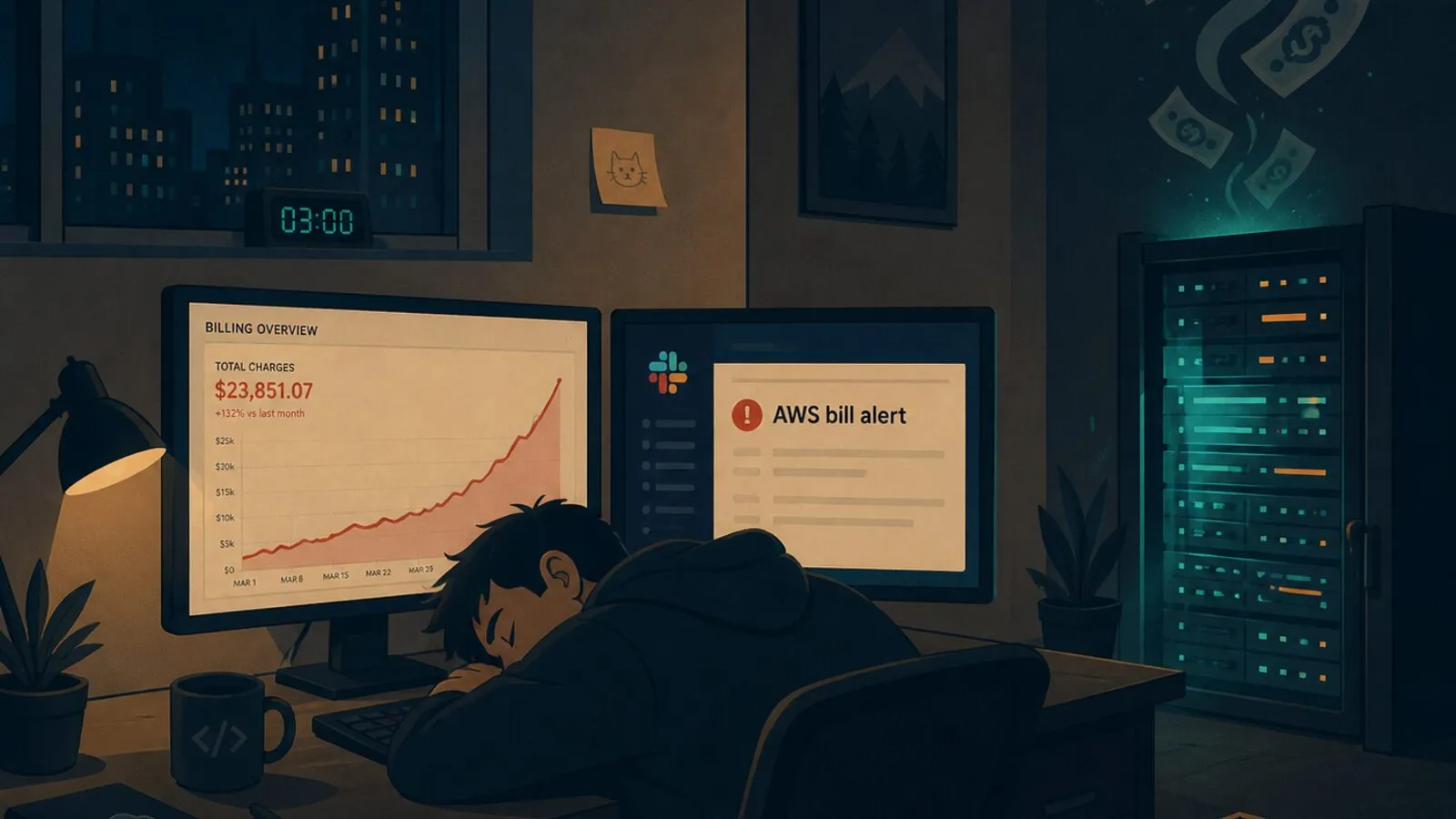
A war story, a cost cut of up to 67%, and the uncomfortable conversation nobody on your team is having.
TL;DR — Velocity stopped being the bottleneck; AI agents fixed that. The bill took its place, and the same agents that ship your code also burn compute like it’s free. One client cut up to 67% of dev VM spend by turning idle infra off when nobody was using it — no re-architecting, just lifecycle.
Some thoughts at 3 AM
A few weeks ago I was looking at a billing dashboard for a client around midnight. Half the engineering team was asleep. The other half was on PTO. Friday night, slow week. And the dev cluster was running flat-out, the staging namespace was fully provisioned, and seven personal VMs that engineers had spun up “just to test something” three sprints ago were still very much alive.
This is where I’m supposed to write something dramatic about waste. I don’t want to. The truth is just kind of boring: nobody had a reason to care.
In 2016, this didn’t matter. Cloud was cheap-ish, growth was the only KPI any VC cared about, and the real bottleneck was shipping speed. We threw engineers and frameworks at that problem for ten years.
Then between 2023 and 2026, AI agents quietly ended the conversation. A team of three with Claude Code or Cursor now ships what a team of ten used to. Velocity isn’t the constraint anymore. It’s not even close.
But here’s the thing nobody warned us about. The same agents that write more code also create more services, which need more infra, which costs more money. And the AI workloads themselves — inference endpoints, vector stores, GPU jobs — are some of the hungriest compute we’ve ever run.
The bill didn’t go down when AI showed up. It went vertical.
Quick math, on-demand prices in us-east-1:
| Instance | What it is | Cost / month |
|---|---|---|
m7a.xlarge | A standard CPU dev box (4 vCPU, 16 GiB RAM) | ~$169 |
g6e.2xlarge | A modest inference GPU (1× L40S) | ~$1,636 |
Roughly 10× more, and we’re not even talking about training-class hardware. Forgetting to turn off a CPU dev VM costs you pennies an hour. Forgetting to turn off a GPU box costs $2.24 every hour, all weekend, every weekend — $54 a day for nothing. Multiply by however many GPU experiments your team has lying around right now.
The 2016 ops playbook didn’t account for this. Most teams haven’t updated.
What the job actually looks like now
Same job title. Different game.
| 2016 | 2026 | |
|---|---|---|
| Real bottleneck | Shipping speed | Cloud cost outpacing revenue |
| How velocity gets solved | Hire more engineers | AI agents (Cursor, Claude Code, Copilot) |
| What gets you promoted | Closed Jira tickets | Margin impact, cost per feature |
| Default infra mindset | Scale up, ignore the bill | Idle = leak |
| Security | Quarterly audit by “the basement guys” | Continuous, AI-assisted scanning |
| Interview question | ”Reverse a binary tree" | "Staging costs $5k/mo and runs 8 hours a day. Fix it.” |
I’m not saying the 2016 skills disappeared. I still write Terraform every week. CI/CD is still the foundation. What changed is what gets you noticed. Shipping a clean pipeline is table stakes. Saving the company $40k a year is a story your CEO will actually tell at the next board meeting.
The part nobody wants to admit
Most DevOps engineers don’t care about the AWS bill.
I’m one of them. I’ve been one of them for ten years. It’s not laziness, it’s just how the job is structured. Nobody shows you the bill. It’s not in your JD. You’re already drowning in incidents and onboarding the eight new microservices someone shipped last week. And there’s no glory in it — nobody has ever high-fived me for turning off a VM.
This gap is structural. It’s also exactly why one of my clients had a problem worth writing about.
The case: e-chat.tech
e-chat.tech is a B2B SaaS company. Standard setup — dev VMs, dev and staging environments on Kubernetes, a real product, real customers.
The team had one DevOps engineer. One. Doing infra, security, on-call, releases, and probably the dishes.
Before they brought in Idlefy, they had tried exactly nothing. Not because they didn’t know about cron-based shutdowns or scale-to-zero. Because the one person who would have implemented it was already underwater. Cost optimization was always next sprint’s problem, and next sprint never came.
The pattern was the most boring possible:
- Dev VMs running 24/7, used during business hours, dead the rest of the time
- Idle on weekends, evenings, holidays, sick days, vacations
- Staging namespaces fully provisioned around the clock for no reason
- No team-level visibility into what was actually being used vs what was just on
What we did was simple. Lease-based scheduling. Every dev VM and every non-prod namespace gets a lease — basically an “alive window.” Before the window closes, the owner gets a Slack ping with a one-click extend; if no one acts, VMs stop and Kubernetes workloads scale to zero. Default state is off, not on. A human always confirms.
Results, with permission to share:
- Up to 67% reduction on dev VM spend per month
- A few thousand dollars per month back on idle Kubernetes environments
- Zero application code changes
- Their DevOps engineer got their evenings back
What surprised me wasn’t the percentage. It was that the savings came from infrastructure that was already provisioned correctly. Right-sized instances. Sane resource requests. Nothing was overprovisioned. The instances were simply running when nobody needed them.
It’s not an architecture problem. It’s a lifecycle problem.
”Just use cron”
Three rebuttals to the comment-section reflex:
- Cron is written by one engineer, maintained by nobody, breaks silently when someone adds a resource without updating the script — and has no way for a developer to extend a lease when they actually need the VM tonight.
- Karpenter and KEDA are reactive. They scale pods to demand, which is the right answer for prod and the wrong question for dev. The dev question isn’t “how many pods?” but “should this whole environment exist right now?”
- None of them touch stateful resources. A scaled-to-zero deployment with an attached RDS and three EBS volumes is still costing real money every hour. Lifecycle has to think about the whole environment, not just the pods.
This is why Idlefy exists — the lifecycle layer isn’t a category yet, and the patches don’t fit.
What I’d actually recommend
If you’re a DevOps engineer reading this, four things.
- Look at the cloud bill weekly. Not monthly, weekly. If you don’t have access, ask for it. That conversation alone signals you’re operating at a senior level, even if your title doesn’t say so yet.
- Measure idle time, not just utilization. A cluster at 30% CPU during business hours is a totally different beast from a cluster at 30% CPU at 3 AM Sunday. Aggregate utilization hides the real waste, and on GPU instances idle time is an order of magnitude more expensive than on CPU.
- Automate the lifecycle, not just the deployment. CI/CD turns code into running resources. You also need something that turns running resources off when they’re not needed. Most teams have the first half and not the second.
- Translate findings into business language. “We’re wasting $X/month” lands. “The cluster has poor temporal utilization” doesn’t. I’ve watched this play out in too many meetings to count.
If you’re a founder or CTO with a one-person DevOps team: assume cost optimization isn’t happening unless you’ve explicitly made it someone’s job and given them the time to do it. And if your team is using AI agents to ship faster, your cloud bill is already growing faster than you think.
Disclosure
I’m the founder of Idlefy. It’s the platform e-chat.tech used for the lifecycle automation I described. We do lease-based scheduling for cloud VMs and Kubernetes environments across AWS and GCP — humans set the leases and approve extensions; we just handle the bookkeeping and the off switch.
I included this case because the numbers are real and we got permission to share them. If you’d rather solve this with cron and a custom controller, go for it. The article isn’t about the tool. It’s about the fact that in 2026, ignoring idle infrastructure costs isn’t a neutral choice anymore. It’s a position you’re taking on your company’s margins, whether you mean to or not.
The 2016 version of DevOps is finishing its shift. Whatever the 2026 version is, it has to know what things cost.
If any of this resonated, I’d like to hear how your team handles non-prod lifecycle. For the origin story behind Idlefy itself, see Minus $5,000 for the weekend. The RSS feed has more posts in this thread.